Sensitivity and specificity in diagnostic assays
Sensitivity and specificity are two important measures used to evaluate the performance of diagnostic tests. They help determine how reliably a test detects its intended target and how effectively it avoids incorrect results.
Understanding these parameters is essential when developing reliable diagnostic assays and balancing the risk of false-positive and false-negative results.
What is sensitivity?
Sensitivity describes how well a test identifies samples that contain the target. High sensitivity means fewer false-negative results.
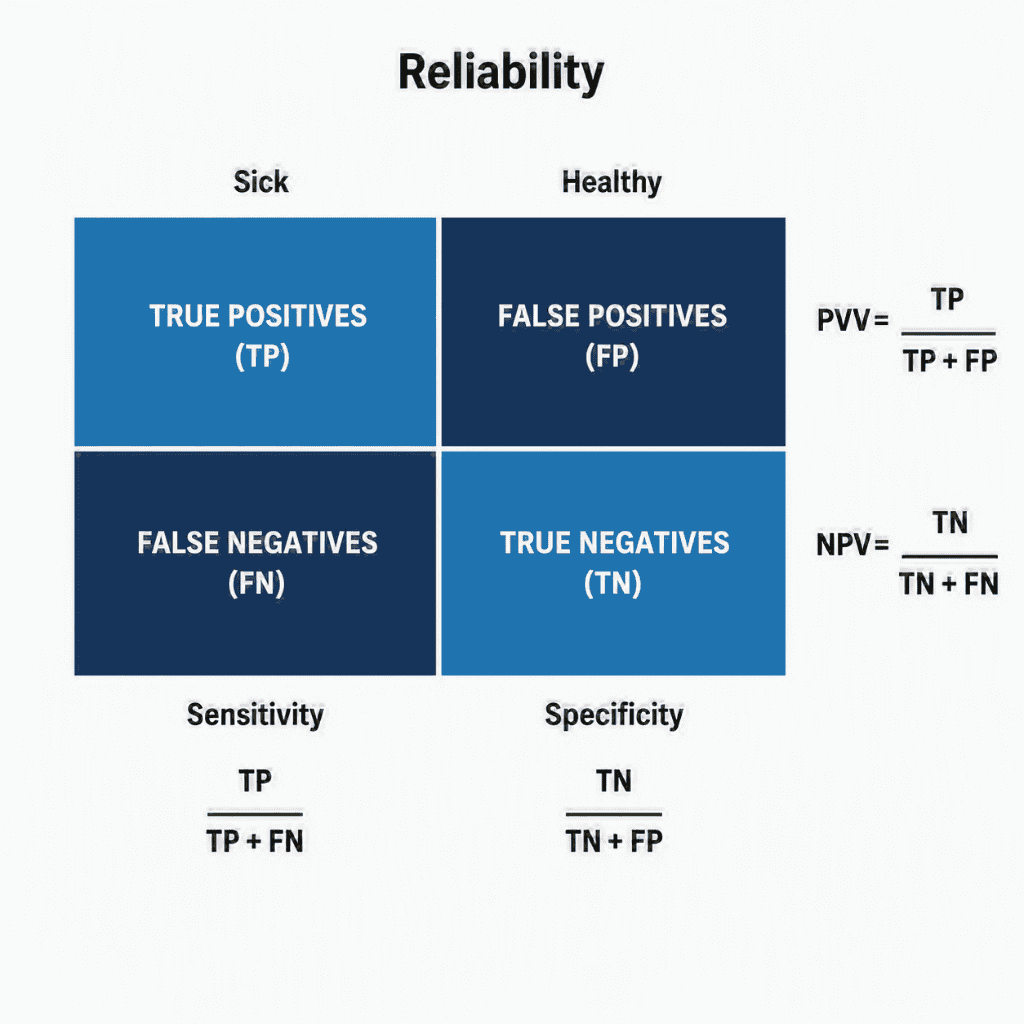
Sensitivity = True Positives / (True Positives + False Negatives) × 100%
For example, if a test correctly identifies 95 out of 100 samples containing the target, its sensitivity is 95%.
Sensitivity can be influenced by the amount of target present, the sample collection and timing, antibody affinity and the assay’s detection capabilities.

Analytical vs. clinical sensitivity
Analytical sensitivity describes an assay’s ability to detect small amounts of a target analyte. Clinical sensitivity describes how effectively a diagnostic test identifies individuals who have the condition being tested for. Clinical sensitivity can depend on factors such as disease stage and sample timing.

What is specificity?
Specificity describes how well a test correctly identifies samples that do not contain the target. High specificity means fewer false-positive results.
Specificity = True Negatives / (True Negatives + False Positives) × 100%
For example, if a test correctly identifies 98 out of 100 samples without the target, its specificity is 98%.
In immunoassays, specificity can be affected by antibody cross-reactivity, non-specific binding and interfering substances.
Sensitivity vs. specificity
Although they are often mentioned together, sensitivity and specificity measure different aspects of assay performance.
| Sensitivity | Specificity |
| Detects the target when it is present | Correctly excludes the target when it is absent |
| Focuses on true positives | Focuses on true negatives |
| Low sensitivity → more false negatives | Low specificity → more false positives |
In short: sensitivity asks “Can we detect it?”, while specificity asks “Are we detecting the right thing?”
Both are important when developing a reliable diagnostic test. Increasing sensitivity does not automatically guarantee high specificity, so the intended application should guide the balance between the two.
What are PPV and NPV?
Sensitivity and specificity describe how well a diagnostic test performs. Positive predictive value (PPV) and negative predictive value (NPV) indicate how likely a positive or negative test result is to be correct.
- Positive predictive value (PPV): the probability that a positive result is a true positive.
- Negative predictive value (NPV): the probability that a negative result is a true negative.
How are PPV and NPV calculated?
PPV and NPV can be calculated using the following formulas:
PPV = TP / (TP + FP) × 100%
NPV = TN / (TN + FN) × 100%
Where:
- TP = True positives
- FP = False positives
- TN = True negatives
- FN = False negatives
Why does prevalence matter?
Predictive values depend on sensitivity, specificity and the prevalence of the condition in the population being tested.
When a condition is rare, a positive result is less likely to be a true positive, even when the test performs well. In populations with a higher prevalence, a positive result is more likely to indicate that the condition is present.
The intended population and purpose of the test therefore need to be considered when interpreting predictive values. For example, a negative result may be particularly useful for excluding a condition when the test has high sensitivity, while a positive result may require confirmation when false positives could have significant consequences.
Sensitivity and specificity in immunoassays
During diagnostic assay and immunoassay development, several factors can influence sensitivity and specificity, including:
- Antibody selection and antibody pair performance
- Assay format and reagent concentrations
- Sample matrix and interfering substances
- Cross-reactivity and non-specific binding
- Detection system and assay conditions
Systematic optimization and appropriate testing help determine whether an assay meets its intended performance requirements.
How does Biocult help balance sensitivity and specificity?
At Biocult, sensitivity and specificity are considered throughout diagnostic test development. We work with customers to define performance requirements that fit the intended application and relevant market expectations.
Through assay development, optimization and performance evaluation, we help identify the right balance between detecting the target reliably and minimizing false-positive results.
The required performance characteristics depend on the intended use of the test and applicable requirements.
HOW WE MODEL END PRODUCTS
IVD test and product development
Frequently asked questions
Sensitivity measures how accurately a diagnostic test identifies samples or individuals with the target condition, while specificity measures how accurately it identifies those without it. High sensitivity helps reduce false-negative results, whereas high specificity helps reduce false-positive results.
Sensitivity is calculated by dividing true positives by the sum of true positives and false negatives. Specificity is calculated by dividing true negatives by the sum of true negatives and false positives.
- Sensitivity = TP / (TP + FN) × 100%
- Specificity = TN / (TN + FP) × 100%
Analytical sensitivity describes an assay’s ability to detect low concentrations of a target analyte, often evaluated using its limit of detection (LOD). Clinical sensitivity describes the proportion of individuals with a condition who are correctly identified by a diagnostic test.
Sensitivity and specificity influence the positive predictive value (PPV) and negative predictive value (NPV), together with disease prevalence in the tested population. PPV indicates how likely a positive result is to be correct, while NPV indicates how likely a negative result is to be correct.
Sensitivity and specificity can be optimized through antibody selection, antibody pair screening, reagent concentration optimization and evaluation of cross-reactivity and interfering substances. The appropriate approach depends on the assay format, sample matrix and intended application.