Antibody screening and characterization
Accelerate your assay development with custom antibody screening and characterization. We help you identify candidates with the exact specificity and performance needed for your downstream applications
Antibody screening for efficient selection
Provide high-throughput antibody screening to help you rapidly identify the most promising candidates for your assay or biomarker project.
Our screening approach supports:
- Detection of target-specific binders
- Selection of high-performing antibody pairs
- Early elimination of low-value candidates
- Efficient progression to downstream validation
By combining speed with robust experimental design, our screening services reduce development time and improve confidence in candidate selection.
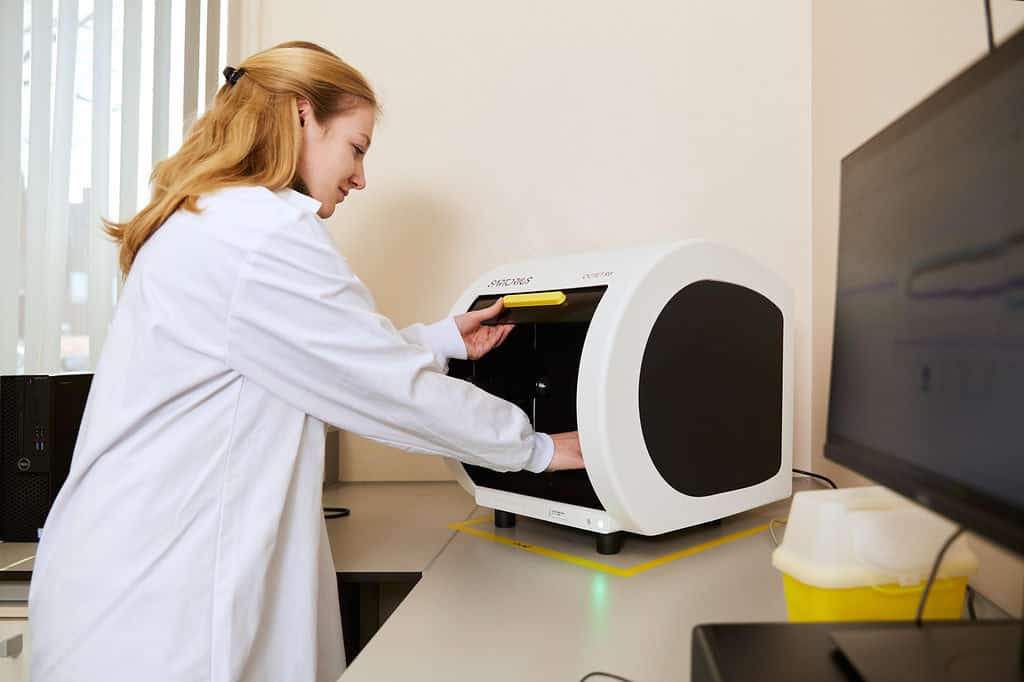
Micro-SCY™
Introducing micro-SCY™: a novel way of antibody-antigen interaction screening
Micro-SCY™ is an innovative method for microarray-based characterization of antibody-antigen interactions, enabling systematic interaction screening in a highly biochemically relevant environment. The technology was developed in-house by Biocults’ assay development experts. Biocult is currently offering micro-SCY™ as a service to IVD and biopharma companies, as well as antibody developers, producers and suppliers.
The benefits of using micro-SCY™ for antibody-antigen interaction screening
Micro-SCY™ enables high-throughput, parallel screening of antibodies and antibody pairs in ultra-low volumes, providing highly translatable data that closely reflects real immunoassay conditions. The platform is fully customizable and delivers a broad range of performance insights, including sensitivity, specificity, binding kinetics, dynamic range, matrix compatibility, and lot-to-lot variation.
Micro-SCY™ applications
The platform is used for antibody and pair screening, clone selection, biomarker assay development, cohort screening for clinically relevant variants, lot-to-lot comparison, production optimization, and performance benchmarking against competitor antibodies.
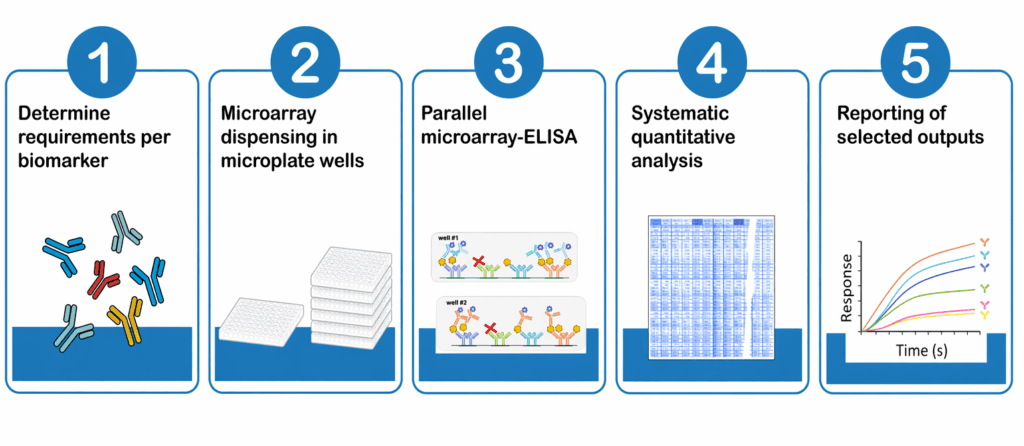
Micro-SCY™ screens antibody-antigen interactions in a microarray-based format in multiwell plates, offering a highly customizable and translatable setup for various antibody-based applications. A typical micro-SCY™ workflow consists of the following steps:
Antibody characterization to confirm performance
After initial screening, we perform antibody characterization to assess whether selected candidates meet the performance criteria required for your intended application.
Characterization services may include:
- Specificity testing to confirm target binding
- Sensitivity assessment to evaluate assay performance
- Cross-reactivity analysis to identify unwanted interactions
- Pair testing for capture and detection antibody selection
- Application-focused validation for assay development
This structured approach helps ensure that shortlisted antibodies are not only reactive, but also suitable for real-world assay conditions.
Bio-layer interferometry (BLI)
We use the Bio-layer interferometry technology Octet (Sartorius) as a versatile and powerful tool for assessing the binding kinetics, specificity, and sensitivity of antibody-antigen interactions.
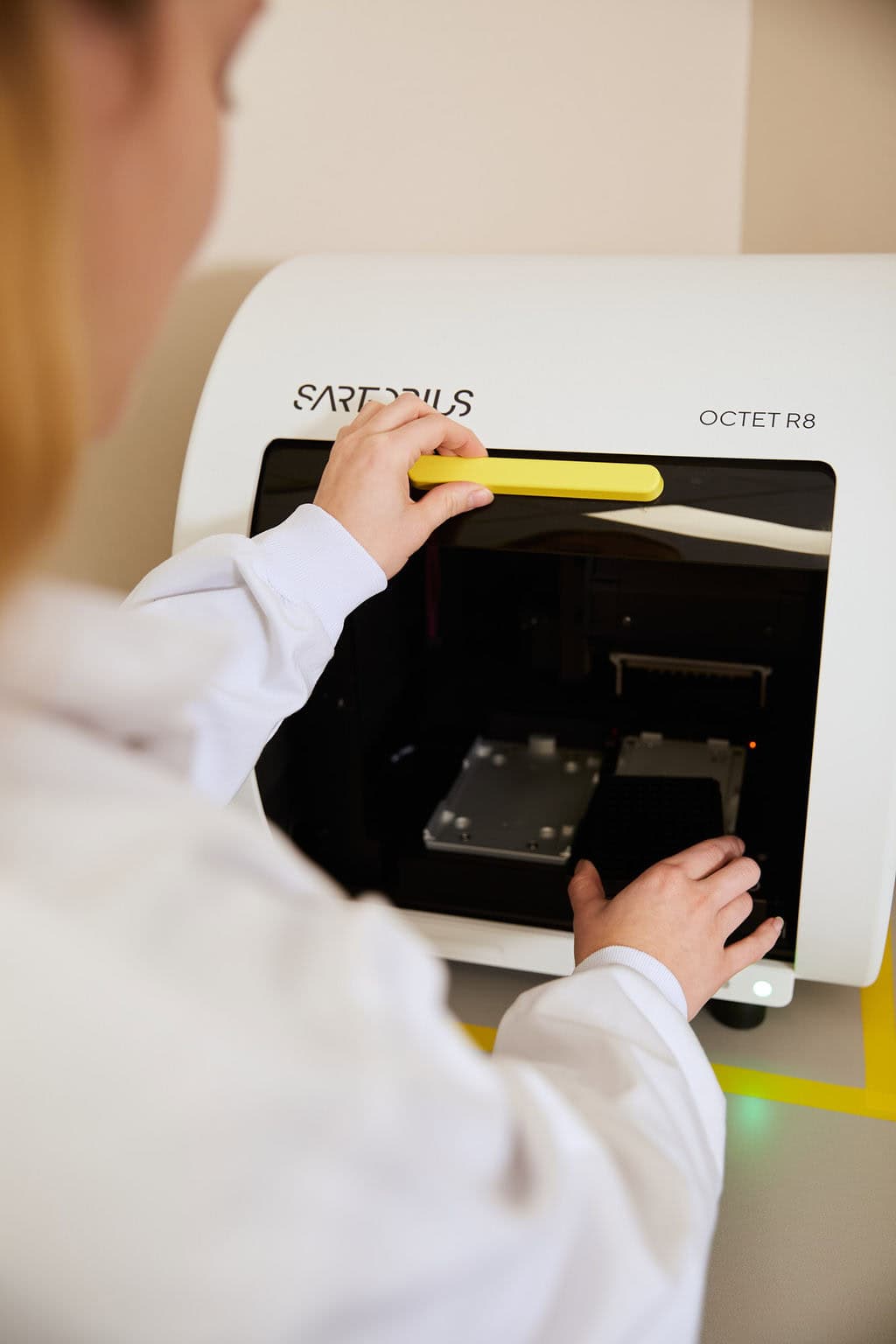
The Octet R8 contains eight spectrophotometers, allowing up to eight samples to be read simultaneously. This instrument includes glass biosensors, the size of a 10 µL pipette tip, coated with a biological component. Depending on the application and desired outcome, the most suitable biosensor can be selected. The Octet is based on Biolayer Interferometry (BLI) which is a dip-and-read system in which the biosensors are moved between different positions in a 96-well plate. BLI is used for label-free, real-time analysis of biomolecular interactions. During measurement, bio-layer interferometry (BLI) detects the interactions occurring on the biosensors. It is an optical analytical technique that analyzes the interference pattern of white light reflected from two surfaces.
The Octet R8 system is equipped with eight spectrophotometers, enabling simultaneous analysis of up to eight samples. The instrument utilizes glass biosensors each approximately the size of a 10 µL pipette tip coated with a specific biological component. Depending on the application and experimental goals, different biosensor types can be selected for optimal performance.
The Octet operates on the principle of Biolayer Interferometry (BLI), a label-free, real-time analytical technique used to study biomolecular interactions. In this dip-and-read system, biosensors are sequentially transferred between wells of a 96-well plate. BLI measures changes in the interference pattern of white light reflected from two surfaces within the biosensor, allowing precise detection and quantification of binding events occurring on its surface.
During an experiment, the biosensors of the Octet are illuminated with white light. The reflection of this light from the biosensors immersed in buffer serves as a reference signal (blue). When molecules such as immobilized proteins bind to the biosensor surface, the optical properties change, causing a measurable shift in the interference pattern (orange). This shift, represented as a change in wavelength (Δλ), is directly proportional to the number of bound molecules. Because Biolayer Interferometry (BLI) measures these changes in real time, it enables precise determination of key kinetic parameters, including association, dissociation, affinity, and concentration. The resulting data are displayed as a binding curve, plotting the wavelength shift against time.
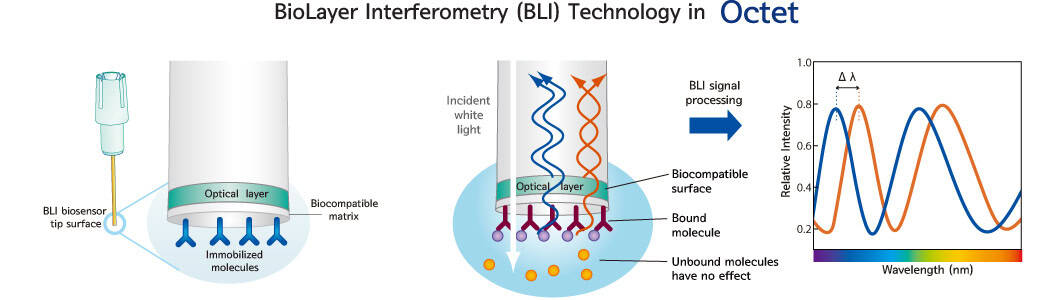
the reflection changes and a shift of the interference pattern occurs (orange). This shift can be translated to a binding curve on the OCTET
Integrated workflow: from screening to quantitative analysis
STEP 1:
Define biomarker-specific requirements:
We start by identifying the technical and performance requirements for each biomarker, including target characteristics and assay format
STEP 2:
Microarray dispensing in microplate wells:
Antibody candidates are dispensed in a microarray format to enable high-throughput screening with minimal sample use.
STEP 3:
Parallel microarray-ELISA screening:
Using a combined screening strategy, antibody candidates can be evaluated in parallel for relevant binding behavior and assay compatibility.
STEP 4:
Systematic quantitative analysis:
Screening data are analyzed in a structured way to identify the most promising antibody candidates based on predefined selection criteria.
STEP 5:
Reporting of selected outputs:
We deliver clear results and recommendations to support your next development steps, including candidate prioritization and assay design decisions.
Binding kinetics analysis for deeper insight
Where needed, we complement screening and characterization with binding kinetics analysis to provide more detailed information about antibody-target interactions.
This can support:
- Affinity ranking
- Comparison of antibody candidates
- Evaluation of interaction strength
- More informed candidate selection for assay development
For this page, it is better to keep this section concise and benefit-focused, because detailed BLI/Octet explanations already appear on related antibody characterization content elsewhere on the site and repeating that wording too closely may increase content overlap.
Why choose Biocult for antibody screening and characterization?
Biocult supports antibody selection with a practical, development-focused workflow designed to deliver both speed and confidence.
What sets our approach apart:
- Integrated screening and characterization workflow
- High-throughput microarray and ELISA-based formats
- Data-driven selection of promising candidates
- Application-oriented development support
- Clear reporting and actionable recommendations
Whether you are evaluating antibody candidates for a new assay or refining an existing panel, we help streamline the path from screening to selection.
Start your antibody screening project
Looking for reliable antibody screening services or support with antibody characterization? Contact us to discuss you project requirements and discover how our development workflow can support you assay goals.
Frequently asked questions
Antibody screening helps identify the most promising antibody candidates for a specific target or application. By evaluating factors such as specificity, sensitivity and binding performance at an early stage, less suitable candidates can be eliminated before moving into further assay development and validation.
Our screening workflow can be adapted to different antibody candidates, targets and assay requirements. Depending on your project, we can support the evaluation of individual antibodies, antibody pairs and candidate panels to identify the most suitable options for your intended application.
Micro-SCY™ is Biocult’s microarray-based technology for screening antibody-antigen interactions. It enables multiple antibodies and antibody pairs to be evaluated in parallel using ultra-low volumes. The approach can provide insight into parameters such as sensitivity, specificity, binding behavior, dynamic range and matrix compatibility.
Yes. Biocult offers an integrated workflow that combines high-throughput screening with further antibody characterization. Selected candidates can be evaluated for characteristics such as specificity, sensitivity, cross-reactivity and suitability for the intended assay application. Binding kinetics analysis can also be included where additional insight into antibody-target interactions is needed.
The process starts with discussing your biomarker, antibody candidates and project requirements. Based on your intended application and performance criteria, we can help define a suitable screening and characterization strategy and provide recommendations for the next development steps.
Bio-Layer Interferometry (BLI) is a label-free, real-time technology used to analyze biomolecular interactions. At Biocult, we use the Octet R8 system to assess antibody-antigen interactions and determine key parameters such as association, dissociation and binding affinity. BLI can provide valuable insight into binding kinetics and interaction strength, supporting the comparison and selection of the most promising antibody candidates.
Start a Project
Let’s make something great together. Feel free to contact us for more information via the contact form.